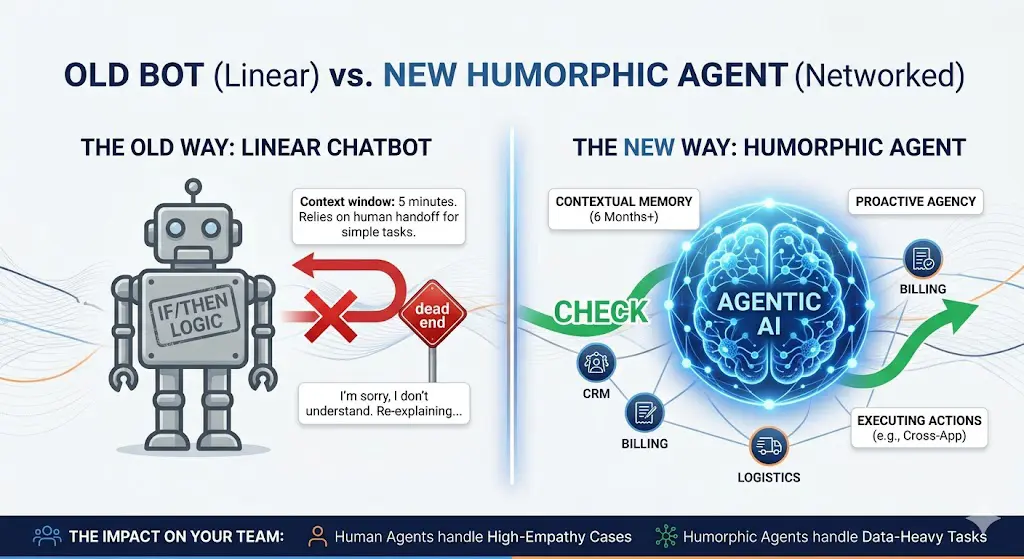
We have all been there. You call a company with a problem you have already explained twice before. The bot asks you to confirm your account number. It misunderstands your request. You hit zero to reach a human — and start over from scratch.
This is not a technology failure. It is a design failure. And it is about to become obsolete.
A new generation of agentic AI customer experience platforms is emerging — systems that do not just respond to customers, but remember them, anticipate their needs, and act across multiple software systems to resolve issues end-to-end. Understanding what this shift means — and how fast it is arriving — matters now, because organisations that move early will build a structural advantage that is difficult to close.
From reactive bots to autonomous agents: what has actually changed
Traditional customer service automation was built on rules. If the customer says X, respond with Y. If the intent matches keyword Z, route to queue three. These systems were efficient for the simplest queries, but unreliable everywhere else.
Agentic AI is a fundamentally different architecture. Rather than following a predefined script, an agentic system can reason across steps, retrieve information from connected platforms, make decisions, and take action — all without a human directing each move. The difference is not incremental. It is categorical.
Gartner has predicted that agentic AI will autonomously resolve 80% of common customer service issues without human intervention by 2029. Cisco’s 2025 global research across 7,950 business leaders found that respondents expect 56% of customer experience interactions to be handled by agentic AI within twelve months — a number rising to 68% by 2028. These are not distant forecasts. Deployments are already live, and the competitive window for early movers is real.
The underlying technology — large language models capable of reasoning across multi-step tasks, combined with integration layers that connect CRM, billing, logistics, and communication platforms — has reached a threshold where real-world production deployment is viable at enterprise scale.
Enter humorphism: a design philosophy for the agentic era
AWS recently introduced a term worth understanding: Humorphism. Announced alongside a significant restructuring of Amazon Connect into a broader family of agentic solutions, humorphism describes a design philosophy that goes beyond making AI sound human. The goal is to make AI behave like a capable colleague — one that carries context, takes initiative, and operates across systems to get things done.
This distinction matters. Anthropomorphism — giving a chatbot a friendly name and a warm tone — has been the industry’s answer to the “robot problem” for years. Humorphism replaces the aesthetic with something structural. Three capabilities define it in practice:
Contextual memory: The agent does not process a ticket in isolation. It understands the customer’s history with the brand — their previous interactions, their relationship timeline, the narrative of their account. When a customer contacts support, the agent already knows the context. The “please repeat your problem” loop disappears.

Proactive agency: Rather than waiting for a customer to raise an issue, a humorphic agent monitors signals — a delayed shipment, a failed payment, an unusual usage pattern — and reaches out before the customer even knows there is a problem. This is the shift from reactive service to anticipatory service, and it has a direct and measurable impact on churn.
Cross-app autonomy: Using integration protocols like MCP (Model Context Protocol), agentic AI is no longer confined to a chat interface. It can navigate your CRM, billing system, logistics platform, and communication stack to actually fix the issue — not just acknowledge it. Resolution, not conversation, becomes the deliverable.
Amazon is not alone in moving in this direction. Salesforce’s Agentforce positions itself as a “digital teammate” operating within the Salesforce ecosystem, deflecting routine inquiries while freeing human agents for the interactions that require genuine empathy and judgment. The pattern is consistent across platforms: the future of enterprise CX is not a better chatbot. It is an AI system that works the way a skilled, well-informed colleague would.
The business case: two problems agentic AI solves directly
For enterprise leaders, the value of this shift resolves to two concrete problems.
Operational cost: Every routine interaction handled by an agentic system is one that does not require a human agent. At scale, this changes the economics of customer service fundamentally. Gartner projects a 30% reduction in operational costs as agentic AI reaches maturity — and Cisco’s data shows the majority of enterprise leaders expect to be running more than half their CX interactions through agentic systems within twelve months. The window for early-mover advantage is real, but it is closing.
Customer churn: PwC’s 2025 Customer Experience Survey found that 52% of consumers stopped buying from a brand after a single bad experience with its products or services, and 29% left due to poor customer service interactions specifically. The loyalty gap between what executives believe and what customers report is significant: 89% of executives believe customer loyalty has grown in recent years, while only 39% of customers agree. Agentic AI — specifically through the elimination of repeat-your-story fatigue and the shift to proactive resolution — addresses the root cause of this gap directly.
The reallocation effect is equally important. When agentic systems absorb the high-volume, data-heavy, repeatable interactions, human agents are freed to handle the moments that define brand loyalty: complex complaints, emotionally sensitive situations, high-value relationships. This is not a story about replacing human teams. It is a story about directing them toward the work they do best.
What deployment actually looks like in 2026
One of the most significant developments in this space is the compression of deployment timelines. Amazon reports enterprise customers moving from concept to live production in weeks rather than months — United Airlines is cited as one example. The structural reason is that modern agentic platforms are designed for business-led configuration, reducing dependence on heavy engineering cycles.
This matters for organisations evaluating the technology today. The decision is no longer whether to move — the competitive and operational logic is clear. The decision is how to move: which use cases to prioritise, which platforms to integrate with, and which implementation partner has the architecture expertise to translate the technology into production-grade deployment.
The right starting point for most organisations is a focused set of high-volume use cases: billing queries, order status, identity verification, basic issue resolution. Instrumenting the right metrics from day one — deflection rate, first contact resolution, CSAT, escalation volume — creates the feedback loop that allows teams to scale systematically.
The Omnicloud perspective
At Omnicloud, we work with enterprise clients navigating exactly this transition — from legacy automation architectures to agentic AI systems that connect across their full technology stack. Whether the environment is built on Salesforce Service Cloud, Amazon Connect, Microsoft Teams, or a hybrid of platforms across regions, the implementation challenge is real and the stakes are high.
The organisations getting this right are not the ones with the biggest budgets. They are the ones that combine a clear use case priority, a sound integration architecture, and a realistic deployment roadmap. That combination — strategy, architecture, execution — is where we spend our time.
If you are evaluating agentic AI for your customer experience operations, or trying to understand how this technology applies to your specific environment, we are happy to have that conversation.
Summary: what to take away
The shift to agentic AI customer experience is not a distant trend. It is an active restructuring of how enterprise CX platforms are built, sold, and deployed — and organisations at both ends of the vendor landscape (AWS, Salesforce, Cisco) are reorganising around it.
The concept of humorphism captures the design intent behind this shift well: not AI that mimics a human in appearance, but AI that operates like a capable colleague — with memory, initiative, and the ability to act across systems. For CX and IT leaders, the questions worth asking now are simple: how much of your current support volume is still trapped in if/then logic? And what would it take to move the most common 20% of interactions to a system that can resolve them end-to-end?
The organisations asking those questions today will be the ones with operational advantage further down in 2026.
Nico Claes is a CX and cloud architect at Omnicloud, a Belgian AI implementation partner that helps enterprise clients navigate and deploy the next generation of customer experience technology. From Salesforce and Amazon Connect to Google Cloud Platform, Omnicloud works alongside its clients — from architecture to production — to turn agentic AI from a concept into a competitive advantage.
Sources
Gartner — Gartner Predicts Agentic AI Will Autonomously Resolve 80% of Common Customer Service Issues Without Human Intervention by 2029 (March 2025)
https://www.gartner.com/en/newsroom/press-releases/2025-03-05-gartner-predicts-agentic-ai-will-autonomously-resolve-80-percent-of-common-customer-service-issues-without-human-intervention-by-20290
Cisco — Agentic AI Poised to Handle 68% of Customer Service and Support Interactions by 2028 (May 2025)
https://newsroom.cisco.com/c/r/newsroom/en/us/a/y2025/m05/agentic-ai-poised-to-handle-68-of-customer-service-and-support-interactions-by-2028.html
AWS / Cloud News — Amazon Transforms Connect into a Family of Agent-Centric AI Solutions for Businesses
https://cloudnews.tech/amazon-transforms-connect-into-a-family-of-agent-centric-ai-solutions-for-businesses/
PwC — 2025 Customer Experience Survey (via Salesforce)
https://www.pwc.com/us/en/technology/alliances/library/salesforce-customer-experience-survey.html