
For years, the conversation around cloud contact centers has been dominated by a single phrase: The single pane of glass. The promise is simple—give your agents one screen where they can handle calls, view customer history, and update cases without ever switching tabs. When Salesforce introduced Service Cloud Voice (SCV) with Amazon Connect as its native engine, it seemed like the ultimate realization of this promise.
However, as many IT directors and Customer Experience (CX) leaders are discovering, the perfect native integration can sometimes come with a restrictive price tag and a rigid operational footprint. While SCV is a powerhouse for front-line agents, it often leaves a critical segment of the workforce in the dark: the back-office teams, the subject matter experts, and the occasional users who are vital to the customer journey but don’t live inside Salesforce 24/7.
This is where the partner solution or a hybrid Amazon Connect implementation becomes a game-changer. By decoupling the telephony and orchestration engine from the seat-based licensing of Salesforce SCV, organizations can unlock massive cost savings and create a truly unified workflow that spans the entire enterprise—not just the contact center.
In this article, we will explore why the Amazon Connect partner model may be the superior choice for complex organizations, focusing on the two pillars of modern business: Cost Optimization and Enterprise-Wide Task Orchestration.
When native becomes expensive
To understand the value of the partner solution, we must first look at the economics of Salesforce Service Cloud Voice. SCV is typically sold on a per-user, per-month license basis. For a full-time contact center agent handling sixty calls a day, this cost is easily justified. The productivity gains of having the Amazon Connect softphone embedded directly into the Salesforce console are immense.
But customer service doesn’t happen in a vacuum. A complex billing dispute might require input from the Finance department. A warranty claim might need approval from a Logistics specialist. A technical escalation might require a developer’s insight.
These back-office employees are incidental users of the contact center. They might handle only two or three customer-related queries a week. Under the standard SCV model, to include these users in the voice or task routing ecosystem, you would need to buy them a full Salesforce Service Cloud license plus the SCV add-on license.
The result? You end up paying hundreds of euros a month for a user who only provides ten minutes of actual customer value. This creates a financial silo where back-office teams are intentionally left out of the integrated system to save money, leading to swivel-chair processes, lost data, and broken SLAs.
Pay-as-you-go for the entire enterprise with Amazon Connect
The Amazon Connect partner solution breaks this cycle by leveraging AWS’s core philosophy: consumption-based pricing.
With Amazon Connect, you don’t pay for the seat; you pay for the usage. If a back-office specialist spends five minutes on a routed task or a consulted call, you pay for exactly five minutes of usage (fractions of a cent).
By using a partner-led implementation, you can maintain your front-line agents in Salesforce while allowing your back-office teams to interact with the same Amazon Connect instance via lighter, more cost-effective interfaces—or even through automated tasks. This allows the business to scale its contact center capabilities to every department without a linear increase in software licensing costs. You transition from a fixed cost per head model to a variable cost per interaction model, which is far more reflective of actual business value.
Orchestrating the Total Experience with Amazon Connect Tasks
Cost is the catalyst for looking at partner solutions, but Amazon Connect Tasks is the functional engine that makes it work.
One of the most misunderstood aspects of the Salesforce-Amazon partnership is that work doesn’t always have to stay inside Salesforce to be tracked. In a partner-integrated environment, you can use Amazon Connect as the central nervous system for all work, regardless of where the worker is located.
Bridging the gap between Salesforce and the back-office
Imagine a scenario where a front-line agent in Salesforce SCV realizes a customer’s refund requires a manual audit by the Finance team. Instead of sending an email or a Slack message that might get lost, the agent can trigger an Amazon Connect Task directly from the Salesforce Case.
The beauty of this is SLA parity. Because the task lived within the Amazon Connect ecosystem, the business can report on exactly how long that Finance specialist took to respond, using the same real-time and historical analytics used for the front-line agents.
Because Amazon Connect is the engine, it can route that task to a Finance Queue. A member of the Finance team, who does not have an expensive Salesforce license, can receive that task in a simple AWS-hosted portal or a lightweight custom interface. They complete the work, and the status update is pushed back to Salesforce via API.
The multi-application ecosystem
The true power of the partner solution shines when you move beyond Salesforce entirely. Most modern enterprises use a constellation of applications: Billing systems (like Zuora or Stripe), ERPs (like SAP or Oracle), and specialized Project Management tools.
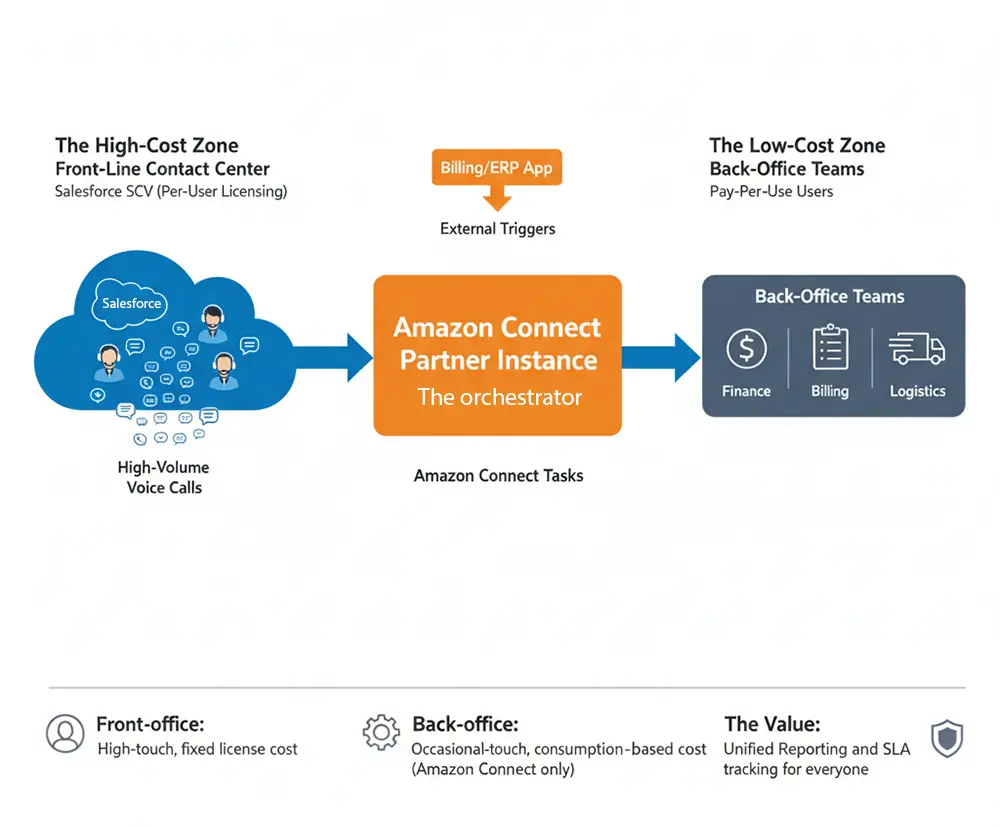
In a Salesforce-only mindset, every trigger for work must first flow into Salesforce to be assigned. But what if your Billing application detects a failed high-value payment?
With a standalone or partner Amazon Connect implementation, the Billing application can send an outbound trigger (via an API or AWS Lambda) directly to Amazon Connect. This creates a Task that is immediately routed to a specialized retention agent or a collections officer.
Business process automation (BPA) and the unified data stream
When you use Amazon Connect as a broader orchestration layer, you aren’t just saving on licenses. You are automating the flow of the business.
In a traditional setup, Voice is one silo, CRM is another, and Back-Office Work is a black hole. By using Amazon Connect Tasks and the partner integration model, you create a unified data stream.
Is the Amazon Connect partner solution for you?
While Salesforce SCV is an incredible product for organizations that want a turnkey solution for their primary agents, the Amazon Connect Partner Solution is the strategic choice for organizations that:
Final Thoughts: moving from contact center to customer engine
The added value of the Amazon Connect partner solution isn’t just a technical preference, it’s a financial and operational strategy. It acknowledges that the contact center is no longer a department—it is a capability that should extend to every corner of the company.
By leveraging the pay-per-use model of Amazon Connect for infrequent users and using Amazon Connect Tasks to orchestrate work across disparate systems, businesses can finally break down the walls between the front-line and the back-office.
The result is a more agile, cost-effective, and transparent organization where every task is tracked, every SLA is measured, and every customer interaction is handled with precision—without the tax of unnecessary enterprise licenses. If you are looking to scale your service strategy while keeping a tight grip on ROI, it’s time to look beyond the native bubble and explore the power of the Amazon Connect partner ecosystem.