
Across Europe, many CX leaders feel caught between boardroom expectations (“we need AI now”) and the reality of running a stable contact center every day. Budgets are under pressure, customer expectations keep rising, and every vendor claims their solution is “AI‑powered.” It’s no surprise that a lot of leaders feel more confusion than clarity.
In this article, we focus on where AI already delivers tangible value in contact centers today, and where it is still overhyped. We will also briefly show how Amazon Connect, AWS’s cloud contact center platform, can support a realistic AI roadmap without forcing you into a risky “big bang” change.
Why AI in contact centers is at a crossroads
AI in customer service is not new, but the recent wave of generative AI has triggered a fresh round of big promises. Boards hope for lower costs and better CX at the same time; vendors promise “human‑like” virtual agents and fully automated interactions. Meanwhile, many contact center leaders report that early AI projects were harder than expected and delivered less than promised.
The core tension is simple: AI initiatives are often launched as technology projects, while the impact (positive or negative) is felt in operations. Agents can end up with tools that add complexity instead of removing it, and customers quickly notice when bots are simply a new barrier between them and a human. AI is powerful, but only when it augments your people and fits your real processes, not when it is used as a shortcut around them.
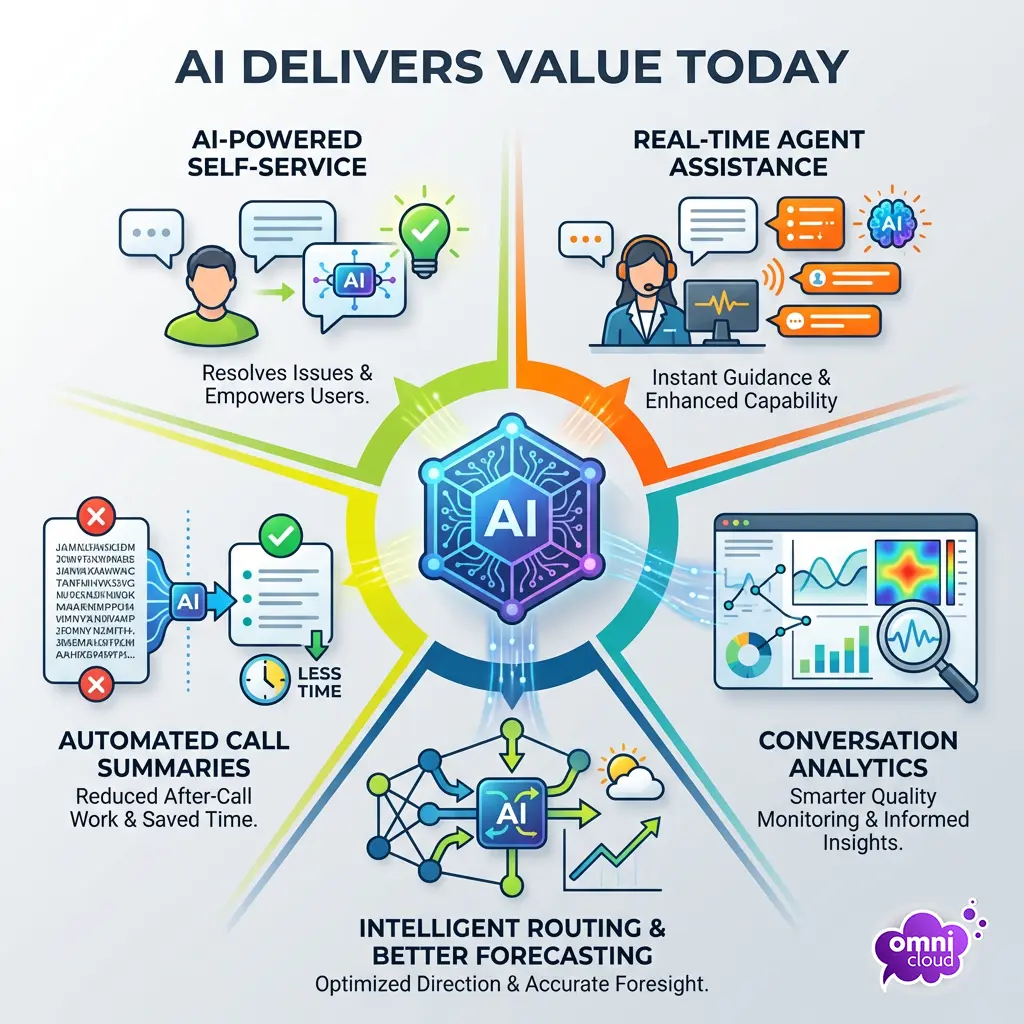
Where AI really delivers value today
AI‑powered self‑service that actually resolves issues
Modern AI can significantly improve self‑service, but only when it is applied to clearly defined journeys. Think about routine, high‑volume questions: “Where is my order?”, “I need a copy of my invoice,” “I want to reset my password,” “I want to change my appointment.” These are ideal candidates for AI‑driven self‑service.
With a platform like Amazon Connect, you can use AI services such as Amazon Lex and generative capabilities behind the scenes to build conversational flows that understand natural language and can complete these specific tasks. The goal is not to make the bot sound like a human, the goal is to allow customers to solve simple issues quickly, 24/7, without waiting in a queue.
When you scope these journeys tightly, integrate with your back‑end systems, and continuously monitor completion rates, AI‑powered self‑service can reduce call volume, shorten queues, and improve customer satisfaction. When you try to automate “everything,” you typically get the opposite.
Real‑time assistance for agents during live conversations
AI is also very effective behind the scenes as a co‑pilot for your agents. During a call or chat, AI can “listen” to the interaction, detect the topic, and surface relevant knowledge or next best steps in real time. Instead of searching through multiple systems or outdated knowledge bases, the agent gets targeted suggestions while they are still talking to the customer.
With Amazon Connect, next‑generation AI features can summarize the customer’s history, highlight previous interactions, and provide contextual guidance for the current conversation. This is particularly valuable in complex environments (for example B2B support, technical products, or regulated industries) where new agents would otherwise need months to become productive.
The concrete impact is lower average handling time, higher first‑contact resolution, and shorter onboarding time for new staff. Most importantly, it makes life easier for agents by removing some of the cognitive load of searching, clicking, and remembering.
Automated call summaries and reduced after‑call work
One of the most visible “quick wins” from AI in contact centers is automated summarisation. Instead of typing notes and manually filling in fields after each contact, AI generates a concise summary of the conversation and extracts key data points: reason for contact, main actions taken, outcome, and agreed next steps.
In an Amazon Connect environment, AI‑generated summaries can be pushed straight into your CRM or case management system. This reduces wrap‑up time, frees agents to move faster to the next customer, and improves the consistency and quality of your data. Better data means better reporting, trend analysis, and forecasting.
From a change‑management perspective, this is a very attractive starting point: agents experience the benefit directly (“less typing, more time”), and operations leaders get more structured insight into what is really happening in the contact center.
Conversation analytics and smarter quality monitoring
Traditional quality monitoring relies on supervisors listening to a small sample of calls every month. It is time‑consuming, often subjective, and covers only a fraction of all interactions. AI makes it possible to analyse 100% of your calls, chats, and emails.
By automatically classifying interactions, detecting sentiment, spotting specific phrases or compliance risks, and identifying recurring topics, AI‑driven analytics can show you where customers struggle and where agents need support. In Amazon Connect, these capabilities can feed dashboards and alerting that help you focus your coaching on the conversations that matter most.
Intelligent routing and better forecasting
The result is a more data‑driven approach to QA and performance: fewer random checks, more targeted coaching, and earlier detection of systemic issues in your products or processes.
Finally, AI can help ensure that every contact reaches the right destination more often. Instead of relying only on static IVR menus and simple skills‑based routing, you can use intent detection and historical patterns to route customers to the best resource: a specialist team, a specific language group, or even a well‑designed self‑service flow.
In parallel, AI‑based forecasting can improve staffing decisions by learning from historic volumes, seasonal patterns, marketing campaigns, and external events. For European mid‑market centers, where small changes in headcount can have a big financial impact, more accurate forecasting and routing can make a real difference to service levels and costs.
Where AI is overhyped (for now)
“We will replace most of our agents with bots next year”
This is probably the most persistent myth. Yes, AI can handle a significant share of repetitive contacts, and that share will grow over time. But the more complex, emotional, or high‑value an interaction is, the more customers want to speak to a human who can understand nuance and exercise judgment.
Replacing large parts of your frontline with bots in the short term usually leads to frustrated customers, higher escalation rates, and more pressure on your remaining agents. A more realistic strategy is to use AI to filter out the simple interactions and to support agents on the complex ones, not to remove the human element altogether.
“We can just plug in AI and it will fix our broken processes”
AI is often sold as a quick fix for years of accumulated complexity: fragmented systems, poor knowledge management, inconsistent processes. In reality, AI amplifies whatever you already have. If your knowledge is outdated, AI will simply deliver wrong answers faster. If your routing rules are unclear, AI will struggle to learn meaningful patterns.
Successful AI projects begin with solid groundwork: clear use cases, clean data, well‑defined processes, and robust integrations. This is less glamorous than a flashy demo, but it is exactly where mid‑market organisations can differentiate themselves: by doing the basics well, they can achieve results that some larger enterprises still struggle to realise.
“Generative AI will understand every customer perfectly”
Recent advances in generative AI are impressive, but they do not make technology infallible. Models can still misunderstand accents, struggle with noisy lines, and misinterpret sarcasm or emotion. They can also produce confident but incorrect answers if they are not guided and constrained properly.
For customer‑facing scenarios, you need clear guardrails: well‑designed prompts, strong boundaries on what the AI is allowed to do, and a smooth hand‑off to human agents when confidence is low. Testing with your real customer base, in your languages and markets, is essential before you rely on AI at scale.
A pragmatic approach to AI in your contact center
If you are leading a European mid‑market contact center, you probably do not have the luxury of multi‑year experimental programs. You need measurable impact within months, not years, and you need to protect the stability of day‑to‑day operations.
A pragmatic approach usually looks like this:
Where Omnicloud and Amazon Connect can help
At Omnicloud, we work with companies that want to modernise their contact centers without falling into the usual traps of over‑promising and under‑delivering. Our focus is on business analysis, solution architecture, and project guidance around Amazon Connect as a contact center platform.
For AI specifically, that means:
If you are considering AI for your contact center and want a “reality check” before committing budget, we offer a focused workshop where we map your current situation, identify 2–3 feasible AI scenarios with Amazon Connect, and outline what you need in terms of data, processes, and skills to make them work.
You leave with a concrete, actionable AI roadmap – not just another slide deck full of buzzwords.