A successful AI solution implementation doesn’t start with technology — it starts with a problem worth solving. For Wortlex, that problem was deceptively simple: WordPress website administrators spend a surprising amount of time hunting for answers. Which plugin handles this? Why does that setting exist? Does this conflict with my theme? The documentation exists — scattered across plugin pages, release notes, forum threads — but surfacing the right answer at the right moment is slow, frustrating work. We set out to fix that, and in doing so, ran a complete AI solution implementation lifecycle from idea all the way through to a live, production system.
This article walks through every phase of that journey. It’s written for companies considering their own AI implementation — whether you’re evaluating where to start, choosing a cloud platform, or trying to understand what “production-ready” actually means in practice.
Phase one: defining the problem – the foundation of any AI implementation
The most common failure mode in AI solution implementation is building a solution before fully understanding the problem. We avoided this by anchoring Wortlex in a single, clear insight: generic answers are rarely useful. A WordPress administrator running WooCommerce with a particular payment gateway and a bespoke theme doesn’t need a broad article about plugin conflicts — they need an answer grounded in their specific environment.
That distinction — contextual versus generic — became the north star of the entire implementation. From the first whiteboard session, we committed to building something that could give each user answers relevant to their actual WordPress setup, not just a one-size-fits-all knowledge base response.
“The best AI solution implementations are built backwards from a specific user need — not forwards from a technology capability.”
We also identified a second requirement early: safety. An AI system embedded in someone’s website administration panel needs strict guardrails. It must refuse off-topic queries, resist adversarial prompts, and stay within a defined knowledge boundary. Security and contextual accuracy would need to be designed in — not added as an afterthought.
Phase two: architecture design – the choices that shape an AI solution
With a clear problem definition in hand, we moved to architecture. This is where AI solution implementations often diverge — the right design choices unlock scale and maintainability, while the wrong ones create technical debt that compounds over time. For Wortlex, we made several deliberate decisions.
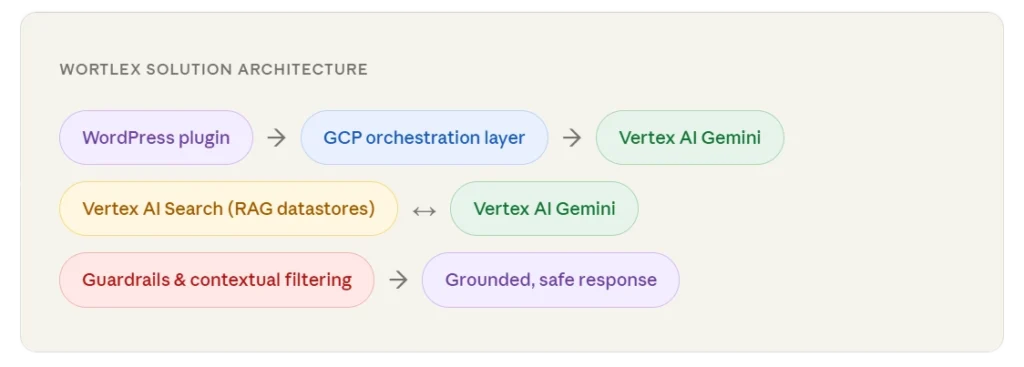
The most consequential architectural decision was choosing Google Cloud Platform as our AI orchestration layer. This wasn’t a default — it was a considered choice made after evaluating alternatives. GCP’s native integration between Vertex AI Gemini and Vertex AI Search meant we could keep generation, retrieval, and data management within a single coherent environment. For a business-class AI implementation, that operational coherence reduces integration risk significantly.
WHY GCP?
Integrated AI stack
Vertex AI Gemini and Vertex AI Search work natively together – one control plane for the full AI solution.
WHY RAG OVER FINE-TUNING?
Dynamic, updatable knowledge
Plugin docs change constantly. RAG datastores let us update context without retraining – keeping the AI implementation fresh automatically.
WHY WORDPRESS-NATIVE?
Meet users where they work
Embedding directly in the dashboard removes friction. A well-implemented AI solution should feel invisible, not bolted on.
HOW DO GUARDRAILS WORK?
Datastores as boundaries
The same datastore that grounds responses also constrains them — the AI only draws from approved, relevant sources.
Phase three: implementation – where AI solution design meets reality
Architecture diagrams are clean. Implementations rarely are. Several important realities emerged as we moved from design to build — each of which shaped the final product in ways worth sharing for anyone planning their own AI solution implementation.
RAG as both knowledge and guardrail. The most elegant discovery during implementation was that the Vertex AI Search datastores we used to ground responses could simultaneously serve as the mechanism for restricting what the AI would engage with. If a question has no resonance in the datastore, the system declines gracefully rather than hallucinating. One component, two jobs — a pattern we’d recommend in any business AI implementation.
Contextual grounding per environment. Each WordPress installation has a different combination of active plugins, themes, and configurations. Making Wortlex understand this context at query time was technically demanding — but it’s precisely this investment that separates a production-grade AI implementation from a capable prototype.
Integration depth drives adoption. We made an early decision to go deep on WordPress integration rather than ship a generic widget. This meant working within the WordPress plugin architecture, respecting its authentication model, and surfacing support in the places administrators naturally look. The extra effort showed in adoption — the solution felt native, not foreign.
IMPLEMENTATION HIGHLIGHT
We built a continuous pipeline to keep datastores synchronised with upstream plugin documentation sources. This means Wortlex always has access to the latest information without manual curation — a critical requirement for any AI solution operating in a fast-moving knowledge domain.
The full AI solution implementation lifecycle
Looking back, Wortlex is a textbook example of what a complete AI solution implementation looks like — including the stages that often get underestimated in planning. Here’s the full cycle as we lived it.
Identifying the real pain point. Defining the non-negotiables — contextual accuracy, safety, and environmental specificity — before writing a single line of code. Every successful AI solution implementation begins here.
Choosing GCP as orchestrator. Selecting Vertex AI Gemini and Vertex AI Search. Designing the RAG datastore strategy and WordPress integration model. Establishing guardrail architecture from the outset.
Implementing the GCP backend, WordPress plugin, and continuous sync pipeline. Discovering the dual-purpose guardrail pattern. Iterating on response quality, grounding accuracy, and contextual specificity per environment.
Stress-testing guardrails against adversarial prompts. Validating contextual accuracy across diverse WordPress configurations. Ensuring the AI implementation stayed grounded and refused off-topic queries reliably before any user exposure.
Wortlex is live and actively supporting WordPress administrators and web agencies. The continuous pipeline keeps knowledge current. The AI solution improves over time — getting more reliable as the WordPress ecosystem evolves.
Lessons learned: what every AI solution implementation should get right
Building Wortlex from scratch gave us a clear view of where AI implementations succeed and where they stall. These lessons apply well beyond WordPress — they’re relevant to any organisation planning a business-class AI solution.
Contextual specificity is the hardest and most valuable thing to build. Most teams default to a central knowledge base and call it done. The additional engineering to make responses environment-aware is significant — but it’s also what drives genuine user trust. Generic AI answers erode confidence; specific, grounded answers build it. This distinction should inform architecture from day one of any AI solution implementation.
Guardrails are architectural, not cosmetic. We designed safety into Wortlex by making the knowledge datastores the hard boundary for AI behaviour. Teams that bolt on moderation layers after the fact play perpetual whack-a-mole with edge cases. Build the fence before you open the gate — that’s a principle we carry into every AI implementation engagement.
Continuous knowledge pipelines are non-negotiable in dynamic domains. An AI solution that was accurate at launch but goes stale over time quickly becomes a liability. Our investment in a continuous sync pipeline was one of the best decisions of the project — it means Wortlex gets more reliable as the WordPress ecosystem evolves, not less.
Integration depth drives real-world adoption. A standalone chat interface would have been easier to build. Going deep into the WordPress admin experience was harder — and far more effective. Adoption follows integration. The more native an AI solution feels, the more naturally users reach for it.
What comes next — for Wortlex and for your AI implementation
Wortlex is in production — but no AI solution in a dynamic environment is ever finished. We’re monitoring how administrators use it, refining datastores, and exploring what the next layer of contextual intelligence looks like. The continuous pipeline means the system learns as the ecosystem evolves.
More broadly, Wortlex validated what we believe at OmniCloud about business AI implementation: the technology is increasingly capable, but the discipline — clear problem definition, thoughtful architecture, deep integration, and safety by design — is what separates AI solutions that genuinely transform operations from ones that merely impress in a demo.
If you’re planning your own AI solution implementation, we’d be glad to share what we’ve learned. The path from idea to production is navigable — but it benefits enormously from experience on the trail.
Planning an AI solution implementation for your business?
OmniCloud specialises in business-class AI implementations — we support businesses in solution ideation & architecture, and project management. Reach out and let’s talk through what the right solution looks like for your environment.